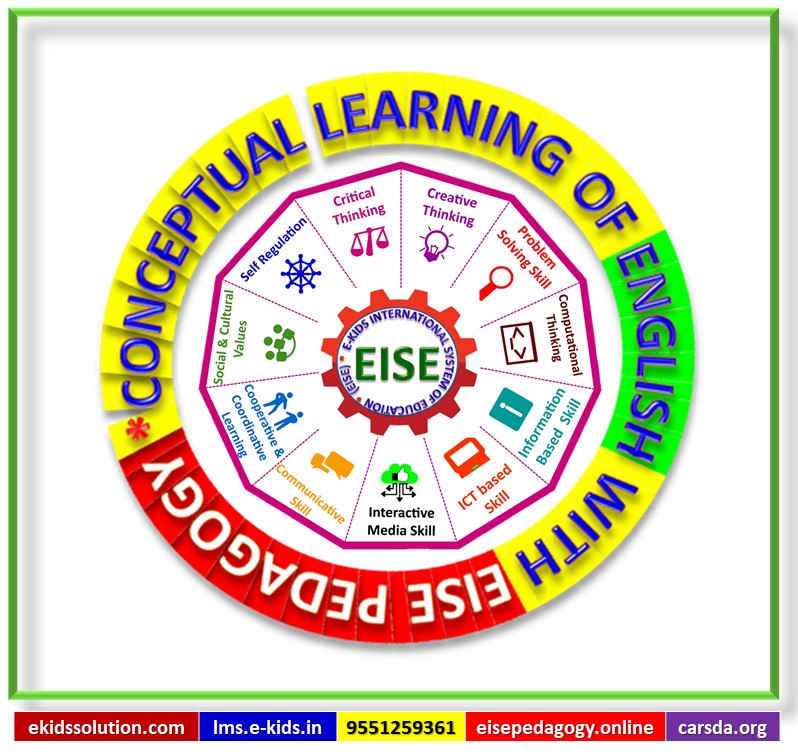
Conceptual Learning of English Education

Concepts in Context: Conceptual Learning of English Education

Conceptual learning of English refers to developing students’ understanding and knowledge of the English language. It involves more than just memorizing vocabulary and grammar rules; it focuses on helping students make connections, think critically, and apply their language skills in various contexts.

Here are some key aspects of conceptual learning of English:

Building foundational language skills

Students develop foundational language skills through exposure to spoken and written English. This includes listening and speaking skills, as well as early literacy skills such as letter recognition and phonics.

Making connections

Conceptual learning of English involves helping students make connections between different aspects of the language. For example, they learn how sounds correspond to letters, how words can be broken down into syllables, and how sentences are structured.

Developing critical thinking skills

Conceptual learning promotes critical thinking skills by encouraging students to analyze language patterns, evaluate meaning, and use context clues to understand unfamiliar words or phrases.

Encouraging active engagement

Conceptual learning of English is most effective when students are actively engaged in using the language. This can be achieved through activities such as storytelling, role-playing, and group discussions where children have opportunities to practice speaking and listening.

Promoting the transfer of knowledge

Conceptual learning aims to help students apply their English language skills in different contexts. Teachers can provide opportunities for children to use English in real-life situations, such as through projects or presentations.

Fostering a growth mindset

Conceptual learning of English encourages a growth mindset, where students believe that their language abilities can be developed through practice and effort. Teachers can support this by providing constructive feedback, praising effort, and creating a supportive learning environment.

Overall, conceptual learning of English in school education focuses on developing children’s language skills, understanding of language concepts, and ability to use English effectively. By fostering curiosity, critical thinking, and active engagement, educators can help students become confident and proficient English language learners.

Conceptual Learning and Teaching in English Education, focusing on Pedagogy, Andragogy, and Huetagogy

Here’s a comprehensive overview of Conceptual Learning and Teaching in English Education, focusing on Pedagogy, Andragogy, and Heutagogy:

Conceptual learning and teaching in English education, particularly when focusing on pedagogy, andragogy, and heutagogy, involves understanding how different learners engage with knowledge and skills at various stages of their educational journey. Here’s an overview of these concepts:

PEDAGOGY

Definition: Pedagogy refers to the art and science of teaching children. It encompasses a range of instructional strategies, theories, and practices aimed at facilitating learning.

Key Characteristics:

  • Teacher-centered approach, where the instructor takes the lead in the learning process.

  • Emphasis on structured learning environments and curricula.

  • Utilizes methods such as direct instruction, guided practice, and formative assessments.

Application in English Education: In teaching English, pedagogy might involve explicit instruction in grammar, vocabulary, reading comprehension strategies, and writing techniques. Engaging younger learners through interactive activities, storytelling, and multimedia resources is essential.

Pedagogy (Teacher-Centered)

1. Direct Instruction: Teachers provide explicit instruction and guidance to introduce new concepts.

2. Structured Lessons: Lessons are planned and structured to ensure coverage of specific learning objectives.

3. Assessment-Driven: Teaching is often driven by assessment requirements, with a focus on measuring student learning outcomes.

4. Teacher as Authority: Teachers are seen as the primary source of knowledge and authority in the classroom.

ANDRAGOGY

Definition: Andragogy is the method and practice of teaching adult learners. It recognizes that adults have different learning needs and motivations compared to children.

Key Characteristics:

  • Learner-centered approach that emphasizes self-directed learning.

  • Adults bring prior experiences and knowledge to the learning environment.

  • Learning is often problem-centered rather than content-oriented.

Application in English Education: In teaching English to adults, Andragogical strategies may include collaborative learning, real-world applications of language skills, and opportunities for learners to set their own goals. Activities could involve discussions, case studies, and role-playing scenarios that reflect adult experiences.

Andragogy (Learner-Centered)

1. Self-Directed Learning: Learners take ownership of their learning, with teachers acting as facilitators or coaches.

2. Experiential Learning: Learning is focused on hands-on experiences and real-world applications.

3. Collaborative Learning: Learners work together to achieve common goals and share knowledge.

4. Focus on Process: The learning process is emphasized, with a focus on developing skills and strategies.

HEUTAGOGY

Definition: Heutagogy is a learner-driven approach that emphasizes self-determined learning. It builds on andragogy but places even more emphasis on the learner’s autonomy.

Key Characteristics:

  • Focuses on developing learners’ capabilities to learn how to learn.

  • Encourages critical thinking, reflection, and adaptability.

  • Learners are empowered to take control of their own learning processes and outcomes.

Application in English Education: In a Heutagogical approach to English education, learners might engage in project-based learning where they select topics of interest, conduct research, and present findings. This could also involve online learning platforms where they can choose resources and learning paths based on their individual needs.

Heutagogy (Self-Determined Learning)

1. Learner Autonomy: Learners have complete control over their learning, with teachers acting as mentors or guides.

2. Self-Reflection and Meta-Cognition: Learners reflect on their own learning and develop strategies for improvement.

3. Contextual and Relevant Learning: Learning is focused on real-world problems and scenarios, with an emphasis on relevance and application.

4. Emphasis on Capability: The focus is on developing learners’ capabilities and competencies, rather than just knowledge acquisition.

Integrating the pedagogy, andragogy, and Heutagogy Approaches

Incorporating elements from pedagogy, andragogy, and heutagogy in English education can create a more holistic learning environment that caters to diverse learners. For example:

* Mixed-Methods Instruction: Use traditional teaching methods for foundational skills while integrating collaborative projects for adult learners that allow for self-direction.

* Reflective Practices: Encourage all learners to reflect on their learning experiences, regardless of age or background, fostering a culture of continuous improvement and adaptability.

* Technology Integration: Leverage technology to provide personalized learning experiences that accommodate different learning styles and preferences.

By understanding these frameworks, educators can better address the varying needs of their students and create effective learning environments that promote engagement and mastery of the English language.

Implications for English Education

1. Shift from Pedagogy to Andragogy and Heutagogy: Moving from a teacher-centred approach to a more learner-centred and self-determined approach.

2. Emphasis on Experiential and Collaborative Learning: Using hands-on experiences and collaborative learning to promote conceptual understanding.

3. Focus on Developing Capabilities and Competencies: Emphasizing the development of learners’ capabilities and competencies, rather than just knowledge acquisition.

4. Use of Technology and Real-World Applications: Incorporating technology and real-world applications to make learning more relevant and engaging.

Conceptual learning is an approach that emphasizes understanding and applying concepts, rather than just memorizing facts. In English education, conceptual learning involves developing students’ ability to think critically, analyze complex texts, and communicate effectively.

Author: Dr. B. Fredy Fernando

EISE Pedagogy and Curriculum Content Developer for Conceptual Teaching and Learning. EISE PEDAGOGY provides structured and progressive curricula for joyful and conceptual learning without books.

Conceptual Learning in Early Childhood Education

Conceptual Learning in Early Childhood Education

Conceptual learning in early childhood education refers to the development of children’s understanding and knowledge of abstract ideas, principles, and relationships. It involves the ability to think critically, make connections, and apply information to new situations.

In early childhood, children are naturally curious and eager to explore the world around them. They learn through hands-on experiences, play, and interactions with their environment and others. Conceptual learning builds on this natural curiosity by encouraging children to ask questions, make observations, and engage in problem-solving activities.

Here are some key aspects of conceptual learning in early childhood education:

Building Foundational Concepts

Children develop foundational concepts through experiences and exposure to various materials and activities. For example, they learn about shapes, colours, numbers, and letters through play and exploration.

Making Connections

Conceptual learning involves helping children make connections between different concepts and ideas. Teachers can facilitate this by asking open-ended questions, encouraging discussions, and providing real-world examples.

Developing Critical Thinking Skills

Conceptual learning promotes critical thinking skills by encouraging children to analyze information, evaluate evidence, and draw conclusions. Teachers can support this by presenting challenging problems or situations that require children to think critically.

Encouraging Active Engagement

Conceptual learning is most effective when children are actively engaged in the learning process. This can be achieved through hands-on activities, experiments, group discussions, and problem-solving tasks.

Promoting Transfer Of Knowledge

Conceptual learning aims to help children apply their knowledge and understanding to new situations. Teachers can promote transfer by providing opportunities for children to use their knowledge in different contexts and encouraging them to explain their thinking.

Fostering A Growth Mindset

Conceptual learning encourages a growth mindset, where children believe that their abilities can be developed through effort and practice. Teachers can support this by praising effort, providing constructive feedback, and creating a positive learning environment.

Why are basic concepts important?

Concept-based learning emphasizes helping children understand the core concept rather than just sharing a layer of important information about the concept. The end motive is to help children understand and retain what they are taught rather than be made to mug up.

Basic concepts are words that depict location (i.e., up/down), number (i.e., more/less), descriptions (i.e., big/little), time (i.e., old/young), and feelings (i.e., happy/sad). Children’s understanding of basic concepts is important for early school success. These are usually taught outright to a child during his/her early years, and learned by listening to adults, following commands, and participating in reading activities. Understanding and using basic concepts help children learn to read and understand what they’ve read or written. They also help children become more effective communicators.

There are five classifications of concepts. These are spatial (location), temporal (time), quantity (number), quality (description), and social-emotional (feelings). Generally, children learn marked concepts or concepts with more distinctive attributes first. These include size, texture, quantity, emotional state, physical attributes, etc. For example, since the idea of thick has more size than thin, it is a marked concept. Upon entering kindergarten, children should understand concepts as pairs, with the unmarked concept understood receptively and the marked concept understood receptively and expressively. Basic concepts help build pre-reading and early mathematics skills, strengthen a child’s vocabulary, and are building blocks of early curriculum.

Significant Reasons Why Conceptual Learning Is Important in Early Childhood Education

Conceptual learning in early childhood education is crucial for a child’s cognitive, social, and emotional development. Here are some significant reasons why conceptual learning is important in early childhood education:

Cognitive Development

1. Building Foundations: Conceptual learning lays the foundation for future academic success. It helps children develop critical thinking, problem-solving, and analytical skills.

2. Understanding Relationships: Concepts help children understand relationships between objects, events, and ideas. This understanding enables them to make connections and think logically.

3. Developing Vocabulary: Conceptual learning introduces children to new vocabulary and helps them understand the nuances of language.

Social-Emotional Development

1. Encouraging Curiosity: Conceptual learning fosters curiosity and a love for learning. Children become enthusiastic about exploring new ideas and concepts.

2. Building Confidence: Children develop confidence in their abilities as they grasp new concepts. This confidence translates to other areas of life, such as social interactions and emotional regulation.

3. Developing Empathy: Conceptual learning helps children understand different perspectives and develop empathy. This is essential for building strong relationships and social skills.

Long-Term Benefits

1. Future Academic Success: Conceptual learning in early childhood sets the stage for future academic success. Children who develop strong conceptual foundations tend to perform better in school.

2. Lifelong Learning: Conceptual learning instils a love for learning that extends beyond childhood. Children develop the skills and mindset necessary for lifelong learning.

3. Critical Thinking and Problem-Solving: Conceptual learning helps children develop critical thinking and problem-solving skills. These skills are essential for navigating an increasingly complex world.

Effective Strategies for Implementing Conceptual Learning

1. Play-Based Learning: Use play-based activities to introduce new concepts and encourage exploration.

2. Storytelling: Use stories to convey complex concepts and make them more relatable.

3. Real-World Applications: Connect conceptual learning to real-world scenarios, making it more meaningful and relevant.

4. Collaborative Learning: Encourage collaborative learning, allowing children to share ideas and learn from each other.

By incorporating conceptual learning into early childhood education, we can provide children with a strong foundation for future academic success, social-emotional development, and lifelong learning.

Conceptual learning and teaching in early childhood education, focusing on pedagogy, andragogy, and heutagogy

Here’s an overview of conceptual learning and teaching in early childhood education, focusing on pedagogy, andragogy, and heutagogy:

Pedagogy (Teacher-Centered)

1. Direct Instruction: Teachers provide explicit instruction and guidance to introduce new concepts.

2. Structured Lessons: Lessons are planned and structured to ensure coverage of specific learning objectives.

3. Assessment-Driven: Teaching is often driven by assessment requirements, with a focus on measuring student learning outcomes.

4. Teacher as Authority: Teachers are seen as the primary source of knowledge and authority in the classroom.

Andragogy (Learner-Centered)

1. Self-Directed Learning: Learners take ownership of their learning, with teachers acting as facilitators or coaches.

2. Experiential Learning: Learning is focused on hands-on experiences and real-world applications.

3. Collaborative Learning: Learners work together to achieve common goals and share knowledge.

4. Focus on Process: The learning process is emphasized, with a focus on developing skills and strategies.

Heutagogy (Self-Determined Learning)

1. Learner Autonomy: Learners have complete control over their learning, with teachers acting as mentors or guides.

2. Self-Reflection and Meta-Cognition: Learners reflect on their own learning and develop strategies for improvement.

3. Contextual and Relevant Learning: Learning focuses on real-world problems and scenarios, emphasizing relevance and application.

4. Emphasis on Capability: The focus is on developing learners’ capabilities and competencies, rather than just knowledge acquisition.

Implications for Conceptual Learning in Early Childhood Education

1. Shift from Pedagogy to Andragogy and Heutagogy: Moving from a teacher-centred approach to a more learner-centred and self-determined approach.

2. Emphasis on Experiential and Collaborative Learning: Using hands-on experiences and collaborative learning to promote conceptual understanding.

3. Focus on Developing Capabilities and Competencies: Emphasizing the development of learners’ capabilities and competencies, rather than just knowledge acquisition.

4. Use of Technology and Real-World Applications: Incorporating technology and real-world applications to make learning more relevant and engaging.

Overall, conceptual learning in early childhood education focuses on developing children’s thinking skills, understanding of abstract concepts, and ability to apply knowledge in meaningful ways. By fostering curiosity, critical thinking, and problem-solving skills, educators can lay a strong foundation for children’s future learning and success.

Conceptual Learning of the English Language

Conceptual Learning of the English Language

Concepts are vital in studies in language and literature courses since they help to organize and guide the study of texts across the three areas of exploration. The concepts interact with the three areas of exploration in numerous ways and contribute a sense of continuity in the transition from one area to the next. They also facilitate the process of establishing connections between texts, making it easier for students to identify different ways in which the texts they study relate to one another. Although they are not explicitly assessed in any component, the concepts constitute an essential part of a student’s investigation and should therefore be included in the discussion of each of the texts studied. 

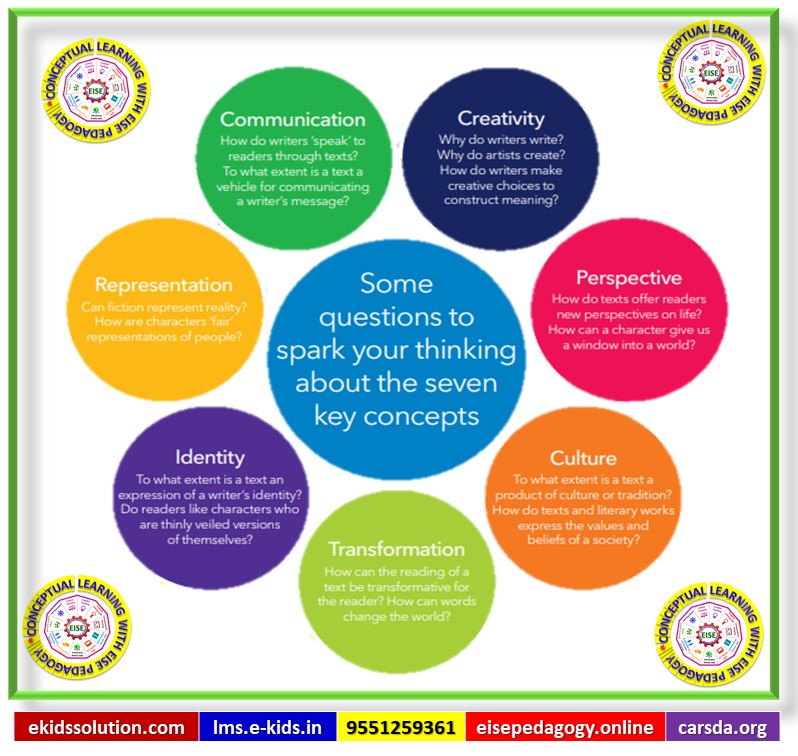
The seven concepts which structure the teaching and learning of these courses have been selected because of the central position they occupy in the study of both language and literature. They foreground aspects of linguistic and literary study that have been the focus of attention and inquiry. Brief explanations of the seven concepts are provided. 

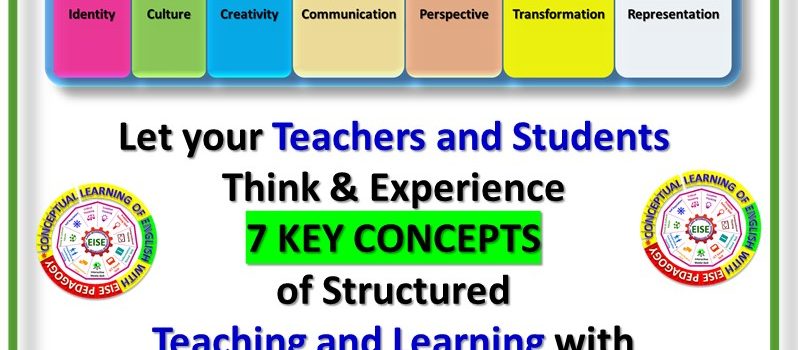
Thinking conceptually about non-literary texts and literary works can be hard. Both the learners and teachers should think about the seven key concepts:

  1. Identity
  2. Culture
  3. Creativity,
  4. Communication
  5. Perspective,
  6. Transformation
  7. Representation

Conceptual Learning – National Education Policy

Rote learning and facts learning are now outdated concepts that were the main methodologies in the old days. The latest modern-day education systems focus more on making students aware of what they are learning, the applied knowledge. This can be achieved only if the basic concepts are clearer from the start of the course.

Classroom methods including institutional methodologies will move away from pure rote learning and will empower thoroughly preparing with conceptual understanding, the improvement of basic goals and atmospheres, analytical and hands-on activities, dialogues, what’s more, a feeling of energy about learning. 

This would require going past the conventional communication approach to utilize instructive methodologies that include student involvement and sharing, applicable hands-on work and hands-on exercises, and encouraging students to analyze learning experiences. Workshops, discussions, gathering and individual ventures are a few examples of educational techniques that can be received. Helpful and peer-upheld exercises can be of great support

The most recent educational strategy, conceptual learning, focuses on understanding vital concepts and arranging data. Unlike traditional learning models, which emphasize the ability to examine specific facts, conceptual learning emphasizes comprehending broader norms or ideas that may then be applied to a variety of explicit models in the real world.

In contrast to the bottom-up learning strategy used in traditional types of learning, conceptual learning takes a top-down approach. In simple terms, conceptual learning is a modern technique for swiftly understanding new concepts and subjects.

Recherche

Recherche (rə-ˌsher-ˈshā) means rare, exotic, obscure, choice, dainty, delicate, elegant, exquisite, fine, or rare.

If we describe something as recherché, that means very sophisticated or is associated with people who like unusual things and of very high quality.

Simplicity is the ultimate recherché.

The most recherché people are inside they are all children.

All the expensive cars, clothes, shoes, bags, jewelry, and other accessories can never make one very refined and recherché. Refinement (improvement) and recherché can only come from a very enlightened (having a rational, modern, and well-informed outlook) mind.

What makes us compassionate (human), is an ability to ask questions, a consequence (significance) of our recherché, enunciated (spoken) language.

The experience of a wise person is nothing but the collective recherché of years.

Digital recherché implies intelligence, profundity (deepness), uniqueness, urban fit, and multidimensional understanding.

Have a Recherche Sunday. Thank You. Shalom.

…………
Think about the Next Generation,
Think about the Future,
Think about Digital Educational Recherché,
Associate with E-Kids International Online Skill Tutoring and be a mentor for the next generations.

https://www.facebook.com/260401103996719/posts/3498590086844455/


E-KIDS INTERNATIONAL
The first #EduSkillTech company since 2003.

EISE Pedagogy – An alternative revolutionary teaching method other than traditional book-based rote learning.